Cultures
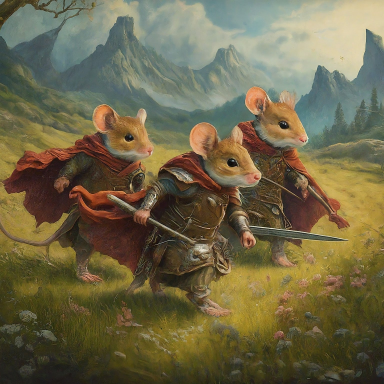
Culture determines the kind of group or society in which the character was raised. This tends to determine a character’s outlooks and philosophies. Culture also determines which of various skills a character starts with or emphasizes during character creation.
There are two mouse cultures: Wild and Settled. Wild mice tend to move or migrate for the resources they need. Settled mice, on the other hand, live in semi-permanent or permanent settlements, which can range from modest homesteads to large villages.
Wild mice are not necessarily uncivilized; it’s more apt to call them nomadic. For example, in a forest Wild mice might be nomads, migrating with the seasons for food and materials while Settled mice might have permanent villages with developed agriculture. The Wild mice could engage in trade with the Settled mice as they migrate, and both Wild and Settled mice could have woodworking, metalworking, animal husbandry, etc.
Another example could be living among humans: Wild mice could live in a city or suburb, foraging from the bounty represented by the trash thrown away in various neighborhoods. Settled mice could live in those same areas, but they’d tend to have more permanent niches carved out, and only move if for example a house were fumigated, or an unpleasant cat were brought home.
Both the Wild and Settled cultures have Standard skills associated with to them. Additionally, players may to pick up to three of the presented Professional skills for each culture.
Detailed Skill Allocation
- Choose three Professional skills from the options listed below in your character’s culture.
- Distribute 100 culture skill points across the culture’s listed Standard skills and whichever Professional skills were selected. Increase each skill by 1% for every point spent on improving it. Game Runners may wish to apply a cap to how many skill points can be applied to any particular skill.
All mice start with the Cultural Fighting Style Unarmed Mouse.
Wild
Tribal in nature, the Wild tend to shun civilisation, viewing those who live in large towns and cities as weak and corrupt. Although their own settlements are also sedentary, they tend to be far smaller and closer to nature. Wild tribes occupy distinct territories, often half tamed wilderness, which they regard as their own for hunting, grazing, and farming purposes. Most are adept in the use of weaponry as they must overcome many dangers throughout their lives – facing creatures of the wilds, or mustering to defend their lands against rival tribes. Since they live in small communities the ties of kinship and clan are strong elements of their society.
Skills
Standard Skills
Athletics, Brawn, Endurance, First Aid, Locale, Perception; and either Boating or Ride.
Professional Skills
Craft (any), Healing, Lore (any), Musicianship, Navigation, Survival, Track.
Settled
The Settled culture is epitomised by a semblance of law and order, underpinned by complex social codes and supported by a bureaucracy. Settled people believe themselves superior to all other cultures because their achievements tend toward permanence: sprawling cities, imposing temples, celebratory monuments, and the recording of history and events in books, tomes and scrolls. Of course, this is a thin veneer. The most Settled of cities can be more lawless than any Wild frontier settlement; and the social codes may be cruder than the hospitality rituals of nomads. But the Settled culture prides itself on its achievements, its infrastructure, its professional artisans and its ability to easily extend its reach to wherever it wishes to go.
Skills
Standard Skills
Conceal, Deceit, Drive, Influence, Insight, Locale, Willpower.
Professional Skills
Art (any), Commerce, Craft (any), Courtesy, Language (any), Lore (any), Musicianship, Streetwise.
Based on Mythras Imperative, Written by Pete Nash and Lawrence Whitaker, and published by The Design Mechanism, Copyright 2023.
Material on this site not covered by other ownership or copyright statements is Copyright © 2024 Robert Prince.